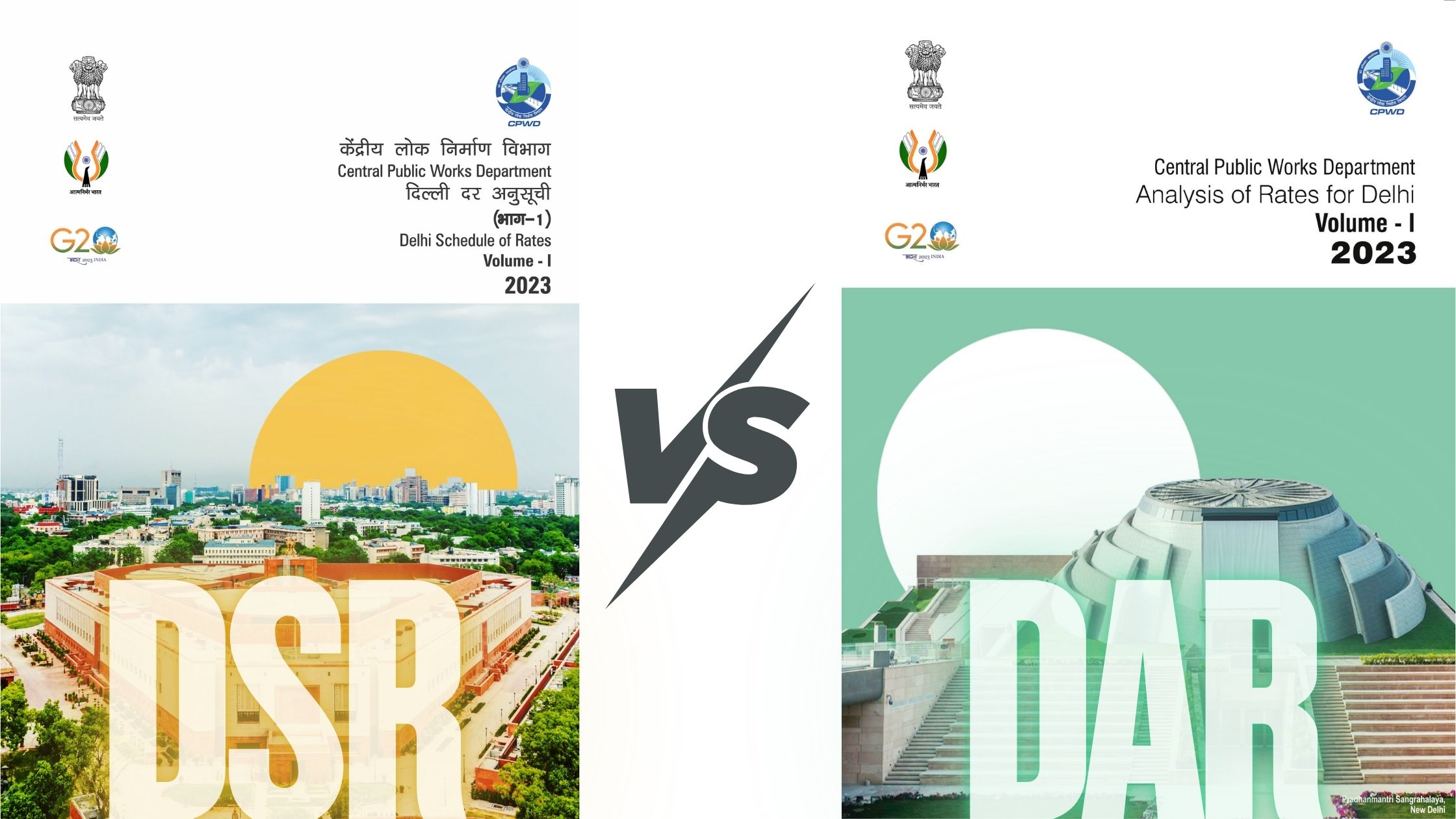
DSR is the rate you quote from; DAR is the analysis you defend from.
In CPWD work, DSR means Delhi Schedule of Rates and DAR means Delhi Analysis of Rates. The DSR gives you the item code, description, unit, and finished Delhi rate. The DAR shows how that finished rate was built: the material, labour, T&P, quantity coefficients, water charges, CP&OH, Labour Cess, and GST behind the number.
That distinction matters because a rate can look official and still be used wrongly. A DSR rate is a published rate for a specific item under specific assumptions. The DAR is what tells you whether those assumptions match your work.
What is the difference between DSR and DAR at a glance?
| Question | DSR | DAR |
|---|---|---|
| Full form | Delhi Schedule of Rates | Delhi Analysis of Rates |
| What it gives | Finished item rate | Derivation of the finished item rate |
| Typical use | BOQ, estimate, abstract, scheduled item lookup | Rate analysis, justification, audit reply, re-analysis |
| What a line contains | Code, description, unit, rate | Basic items, linked items, quantities, rates, amounts, additions |
| Location basis | Delhi base rate | Delhi-base analysis behind that rate |
| For non-Delhi work | Cost Index is usually applied for quick estimates | Local basic rates are used when detailed justification is needed |
| Audit role | Shows the published scheduled rate | Shows whether the rate has been understood and defended correctly |
The simplest way to remember it is this: DSR is like a BOQ with single-unit quantities. DAR is the calculation sheet behind that BOQ.
What does the CPWD DSR contain?
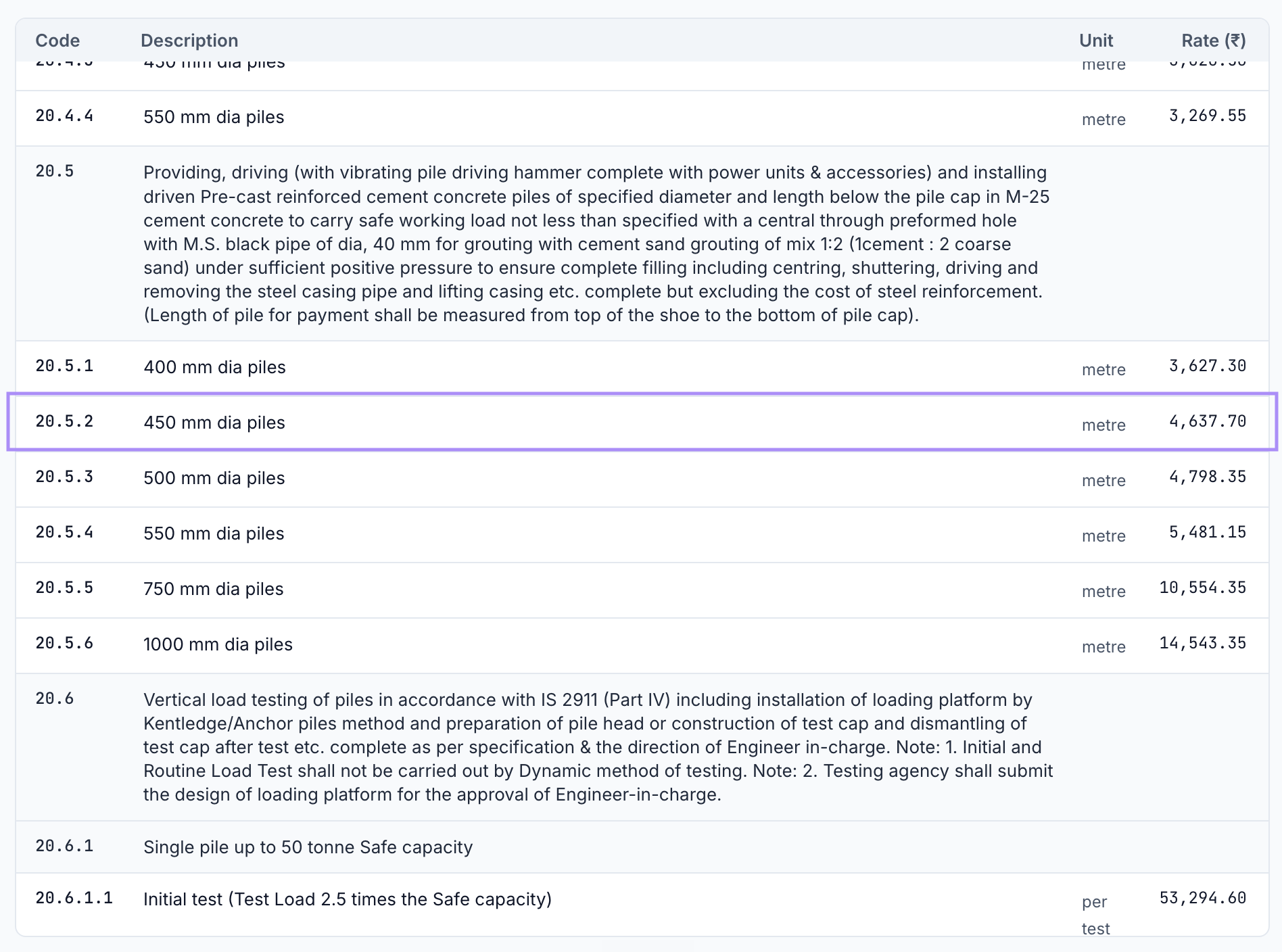
The CPWD DSR is the schedule of rates issued by the Central Public Works Department. Each usable DSR item normally gives you four things: the item code, the item description, the unit, and the rate. Some items also sit under parent headings, and that parent wording can matter because it gives the technical context of the item below it.
This is why copying only the last line of an item can be dangerous. A sub-item may look complete on its own, but the parent item above it may define the scope, exclusions, floor level, material condition, or execution condition. When you prepare a BOQ, the DSR line is enough only if you have read the item in its proper hierarchy.
The word “Delhi” also matters. DSR rates are prepared with Delhi as the base. For other locations, engineers usually apply the relevant Cost Index when preparing estimates quickly. When the rate has to be justified in detail, the better route is to go back to the analysis and rebuild it with current local basic rates.
What does the CPWD DAR contain?
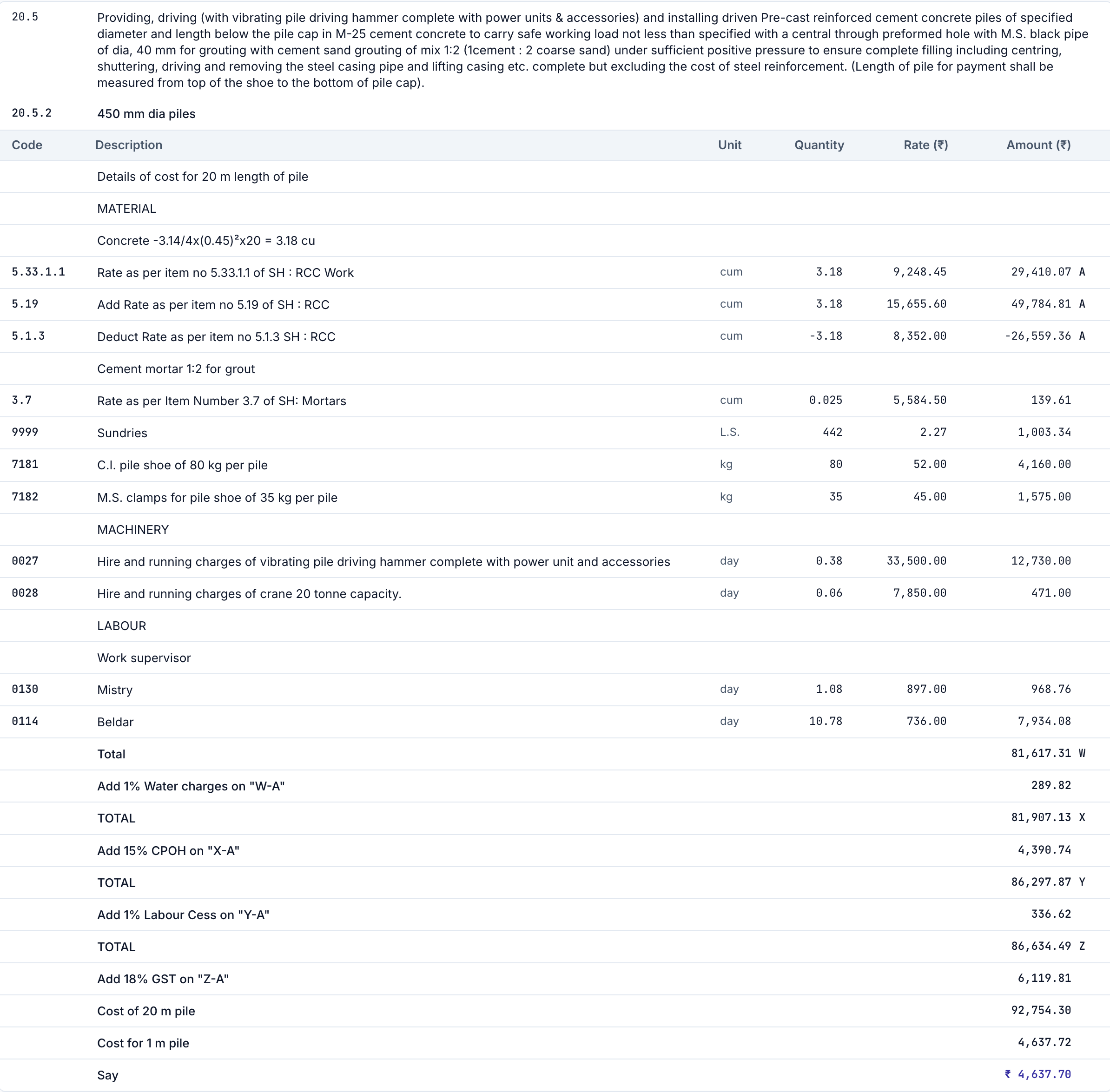
The CPWD DAR is the working behind the DSR. For a scheduled DSR item, it shows how the rate is built row by row.
A DAR analysis usually contains description rows, basic item rows, linked DSR item rows, quantities, rates, amounts, intermediate totals, and statutory or departmental additions. The basic rows are the smallest building blocks: material, labour, machinery, T&P, carriage, and similar inputs. Those inputs are multiplied by their quantities to get row amounts. The row amounts are then totalled and the additions are applied.
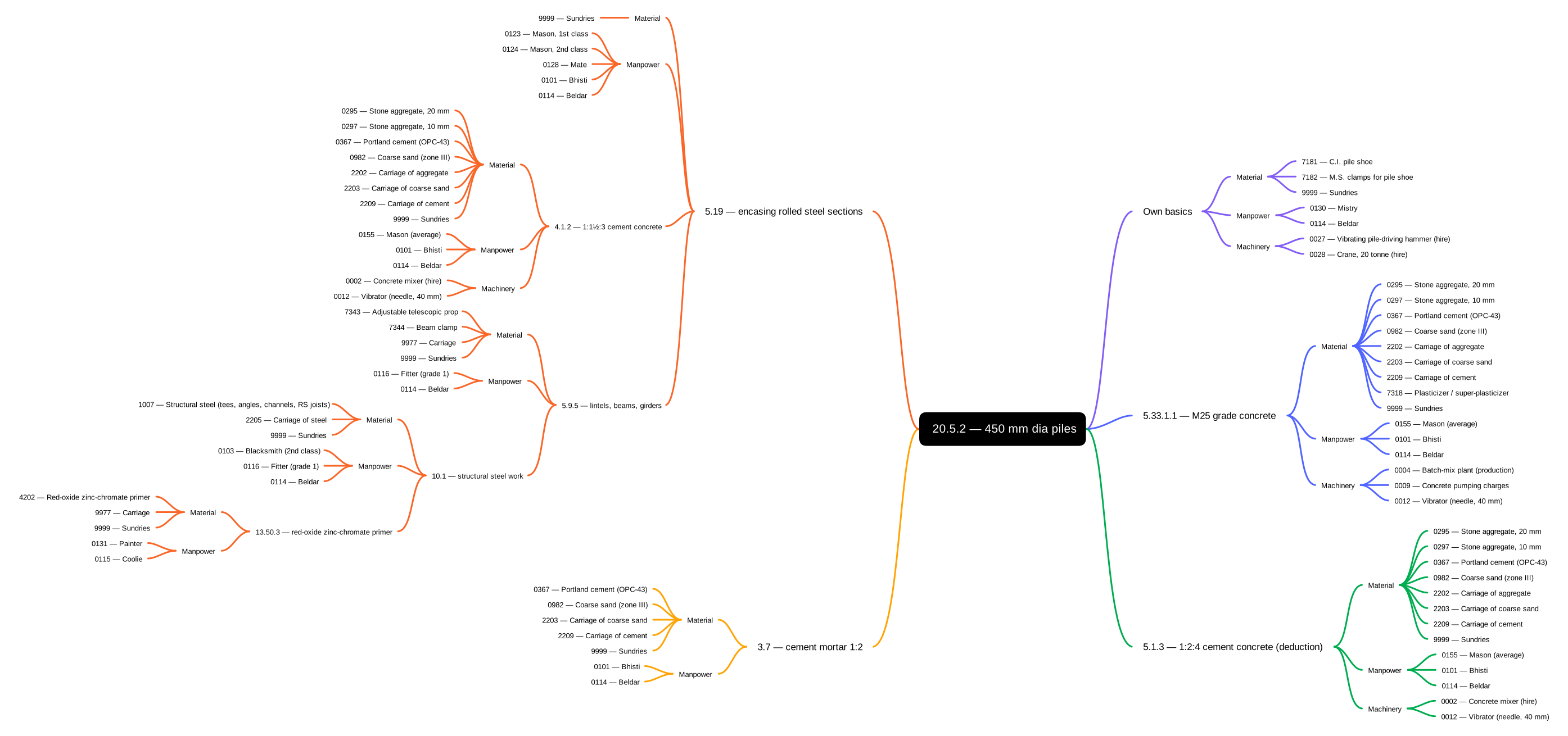
Strictly speaking, those basic items should not be confused with a normal DSR sub-head like Sub-Head 1 or Sub-Head 5. They are the basic item rate list feeding the analysis. The scheduled DSR item is the output. The DAR is the route from the basic items to that output.
This is also why the DAR often answers doubts that the DSR description leaves open. If the item wording feels unclear, the analysis may show whether a material, labour component, machine, wastage allowance, or addition has actually been included.
When should you use DSR and when should you use DAR?
Use the DSR when you are preparing a BOQ, abstract, or estimate using scheduled CPWD items. If the item exists in the schedule and your work matches the item description and conditions, the DSR is the rate reference.
Use the DAR when the rate has to be understood, rebuilt, modified, or defended. That includes rate analysis, tender justification, market-rate justification, non-schedule item preparation, and audit replies. DSR tells you the number. DAR tells you why the number is what it is.
An estimate can be prepared from the DSR. A justification cannot be prepared from the DSR alone. For justification, the analysis has to be rebuilt using the relevant basic rates for that place and time, and then compared with the tendered rates.
Is DAR the same as market-rate analysis?
DAR is not the same as a current market-rate analysis. It is the published analysis of a DSR item at Delhi rates and at the time of publication.
Market-rate analysis uses the same logic, but updates the basic rates. Cement, sand, aggregate, labour, machinery, carriage, and other inputs are taken at current market rates for the project location. The structure of the calculation may follow the DAR, but the rates are no longer the old Delhi-base rates from the book.
So the cleaner statement is: DAR is the model; market-rate analysis is the model rebuilt with current local inputs.
Worked example: how does DAR build the M25 RCC rate?
Take CPWD DAR 2023 item 5.33.2.1, concrete of M25 grade with minimum cement content of 330 kg/cum, under item 5.33 for ready mixed or site batched design mix cement concrete for reinforced cement concrete work. This sub-item applies to all works above plinth level up to floor V level.
The item description is important. It includes pumping of concrete to the site of laying, curing, and carriage for all leads. It excludes centering, shuttering, finishing, and reinforcement. That means the M25 concrete item is not the full RCC member. Reinforcement and shuttering have to be taken separately under their own relevant items.
The printed DAR 2023 analysis for this item, under the older GST methodology, builds the rate like this:
| Code | Component | Unit | Quantity | Rate ₹ | Amount ₹ |
|---|---|---|---|---|---|
| 0295 | Stone aggregate, 20 mm nominal size | cum | 0.57 | 1,425.00 | 812.25 |
| 0297 | Stone aggregate, 10 mm nominal size | cum | 0.28 | 1,400.00 | 392.00 |
| 2202 | Carriage of stone aggregate below 40 mm | cum | 0.85 | 0.00 | 0.00 |
| 0982 | Coarse sand, zone III | cum | 0.425 | 1,450.00 | 616.25 |
| 2203 | Carriage of coarse sand | cum | 0.425 | 0.00 | 0.00 |
| 0367 | Ordinary / Pozzolana / Slag cement | tonne | 0.33 | 5,156.00 | 1,701.48 |
| 2209 | Carriage of cement | tonne | 0.33 | 0.00 | 0.00 |
| 7318 | Plasticizer / super plasticizer | kg | 1.65 | 30.00 | 49.50 |
| 0004 | Production cost by batch mix / ready mixed plant | cum | 1.00 | 450.00 | 450.00 |
| 0009 | Pumping charges | cum | 1.00 | 250.00 | 250.00 |
| 0155 | Mason, average | day | 0.17 | 857.00 | 145.69 |
| 0114 | Beldar | day | 2.00 | 736.00 | 1,472.00 |
| 0101 | Bhisti | day | 0.90 | 816.00 | 734.40 |
| 0012 | Vibrator, needle type 40 mm | day | 0.07 | 400.00 | 28.00 |
| 9999 | Sundries | L.S. | 13.00 | 2.27 | 29.51 |
| Extra cost of additional piping work and accessories up to floor V level | 250.00 | ||||
| Total W | 6,931.08 | ||||
| Add 1% Water Charges on W | 69.31 | ||||
| Total X | 7,000.39 | ||||
| Add GST on X, multiplying factor 0.2127 | 1,488.98 | ||||
| Total Y | 8,489.37 | ||||
| Add 15% CP&OH on Y | 1,273.41 | ||||
| Total Z | 9,762.78 | ||||
| Add Cess @ 1% on Z | 97.63 | ||||
| Say | cum | 9,860.41 |
This table is the DAR doing its job. It tells you why the DSR rate is not just “M25 concrete = ₹9,860.41 per cum.” It shows the 20 mm aggregate, 10 mm aggregate, sand, cement, admixture, production cost, pumping, labour, vibrator, sundries, water charge, GST, CP&OH, cess, and extra piping cost that lead to that rate.
It also tells you what is absent. There is no reinforcement row in this analysis. There is no centering or shuttering row. If those are required in your work, they must come from separate items. This is exactly the kind of detail a junior engineer misses when he reads only the DSR description.
What changed after the CPWD OM dated 08-Aug-2024?
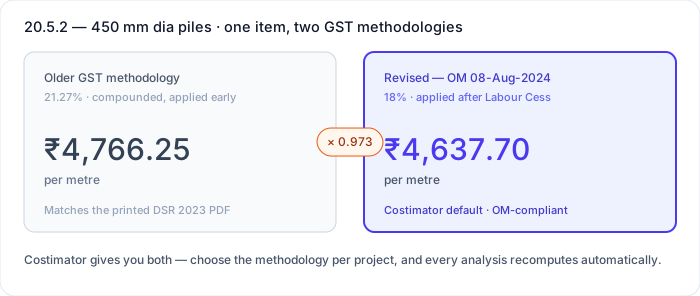
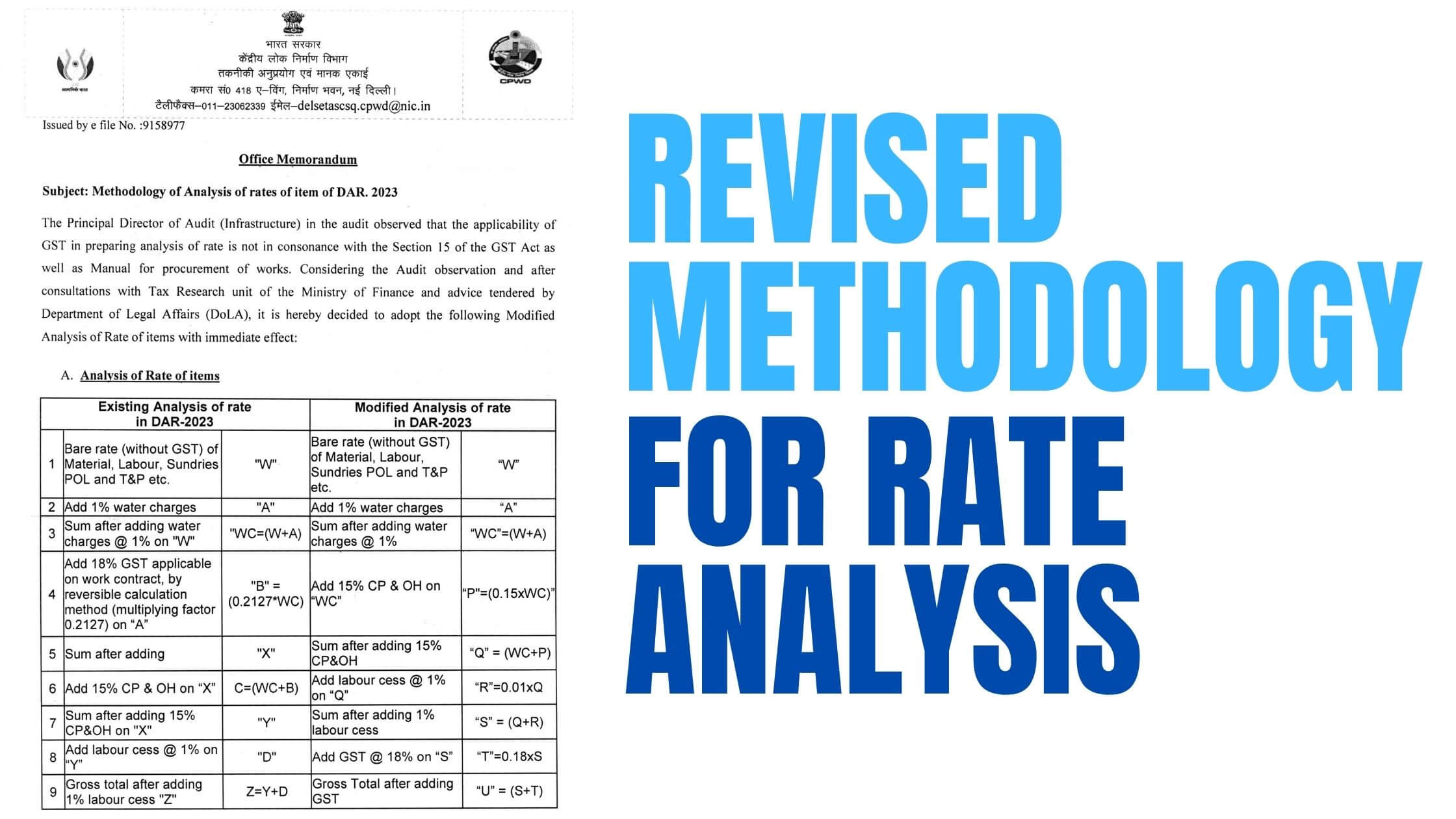
The table above is the printed DAR 2023 method. CPWD later issued OM File No. 158/SE (TAS)/GST/2024/02-E, dated 08-Aug-2024, on the methodology of analysis of rates for DAR 2023 items.
The old method used a reversible GST calculation. In the M25 example above, GST is added on X using the multiplying factor 0.2127, before CP&OH and cess.
The modified method changes the order. It adds 15% CP&OH first, then 1% Labour Cess, and then applies GST at 18% after Labour Cess. The OM also states that, until the modified rates are updated in DSR 2023 / DAR 2023 / ERP module, modified rates can be calculated by multiplying the existing rate by correction factor 0.973.
But the correction factor is only a shortcut. If you rebuild the same item under the modified OM cascade, the calculation becomes clearer:
| Step | Older printed DAR method for 5.33.2.1 | Costimator-current method for 5.33.2.1 |
|---|---|---|
| Total W | 6,931.08 | 6,931.08 |
| Add 1% Water Charges | 69.31 | 69.31 |
| Total after Water Charges | 7,000.39 | 7,000.39 |
| GST step | 1,488.98 using factor 0.2127 | Not applied here |
| Add 15% CP&OH | 1,273.41 after GST | 1,050.06 before cess |
| Add 1% Labour Cess | 97.63 after CP&OH | 80.50 after CP&OH |
| Add 18% GST | Already handled through factor 0.2127 | 1,463.57 after Labour Cess |
| Final rate | 9,860.41 | 9,594.50 |
This is the difference between applying a correction factor and rebuilding the analysis. The correction factor tells you the adjusted rate quickly. The rebuilt analysis tells you where the rate changed.
The full Costimator-current calculation for the same item is:
| Step | Costimator-current analysis for 5.33.2.1 |
|---|---|
| Total W | 6,931.08 |
| Add 1% Water Charges on W | 69.31 |
| Total X | 7,000.39 |
| Add 15% CP&OH on X | 1,050.06 |
| Total Y | 8,050.45 |
| Add 1% Labour Cess on Y | 80.50 |
| Total Z | 8,130.95 |
| Add 18% GST on Z | 1,463.57 |
| Cost per 1.00 cum | 9,594.52 |
| Say | 9,594.50 |
That is a better way to show the change than only saying “multiply the old rate by 0.973.” The multiplication is useful for quick correction. The rebuilt DAR view is useful for engineering judgement.
This GST change deserves its own article because it affects the entire cascade. For this post, the point is simpler: the DSR rate is not a dead number in a PDF. It is the output of an analysis method. When the method changes, the rate has to be corrected or rebuilt.
Why does audit care whether you used DSR or DAR?
Audit does not ask only whether an item exists in DSR. Audit asks whether the rate used in the estimate or tender was reasonable for the work, location, and time.
If you are preparing a quick estimate for a scheduled item, DSR may be enough. If you are justifying a tender, answering an objection, or defending a market rate, the DSR number alone is thin support. The DAR logic has to come in, because that is where the rate can be rebuilt using current basic rates.
This is where many files go wrong. Engineers treat the DSR as a final rate card for tender award. But DSR is a Delhi-base schedule. For a non-Delhi project, the quick estimate may use Cost Index. For detailed justification, the analysis should be rebuilt with the current basic rates of that location. If that work is skipped, the file may invite audit objection, and in sensitive cases, vigilance scrutiny.
What mistakes happen when DSR and DAR are confused?
Treating DSR as tender justification. DSR gives the scheduled rate. It does not, by itself, prove that the tendered rate is reasonable for the current market.
Using Delhi rates without location correction. For quick estimates outside Delhi, Cost Index exists for a reason. For detailed justification, local basic rates matter even more.
Assuming a DSR item includes everything in the work. The M25 RCC example is a clean warning. The item is for concrete. Reinforcement, centering, shuttering, and finishing are excluded in the item description and absent from the analysis.
Adding CP&OH twice. CP&OH is already inside the scheduled rate. If you add it again on top of a DSR rate, the calculation is wrong. If you are changing CP&OH as a bidder-side assumption, the item needs a fresh analysis, not a casual addition.
Using stale methodology after an OM or correction slip. The 08-Aug-2024 GST OM changed the analysis method. A printed PDF table may still show the old cascade. If the correction factor or modified method is ignored, the rate will not match the current CPWD methodology.
How does Costimator handle DSR and DAR?
Costimator includes every CPWD DSR 2023 item and its full DAR breakdown, with all correction slips applied. Click a DSR item and the DAR analysis opens from the same place, so the finished rate and the working behind it stay connected. Every item in Costimator follows the rate analysis cascade defined in the CPWD OM dated 08-Aug-2024, including the GST applied on Labour Cess.
That does not make the engineer optional. It makes the checking easier. You still need to understand why the rate is what it is.
FAQ
Why is it called Delhi Schedule of Rates when CPWD works are all over India?
Because the schedule is prepared on a Delhi-base rate structure. Other locations adjust those rates using Cost Index for estimation, or rebuild the analysis with current local basic rates for detailed justification.
Are CPWD DSR and DAR published together?
They are matching CPWD publications for the same schedule cycle. DSR gives the scheduled item rates. DAR gives the analysis behind those scheduled rates.
Do I need DAR if I am only quoting from DSR?
For a simple BOQ using scheduled items, you may quote from DSR. But if the rate has to be justified, defended, modified, or rebuilt for local market conditions, you need the DAR logic.
Why does my DAR-rebuilt rate not exactly match the published DSR rate?
Common reasons are rounding, using different basic rates, missing a row in the analysis, applying the additions in the wrong order, or using the post-08-Aug-2024 GST method while comparing against an older printed DAR table.
Does DAR apply to non-DSR items?
The CPWD DAR is the published analysis for scheduled DSR items. For non-DSR items, the concept still applies: you prepare an analysis of rate using basic items, quantities, rates, and additions. But the item itself is not a published DSR item.
Is DSR enough for audit?
Not when the rate has to be justified. DSR is a published schedule rate. Audit usually wants to see whether the rate used in the tender or bill is reasonable, and that requires analysis of rates, current basic rates, and proper justification.
The DSR tells you the rate CPWD published. The DAR tells you why that rate exists. Quote from the DSR when the item fits. Open the DAR when the number has to stand up.