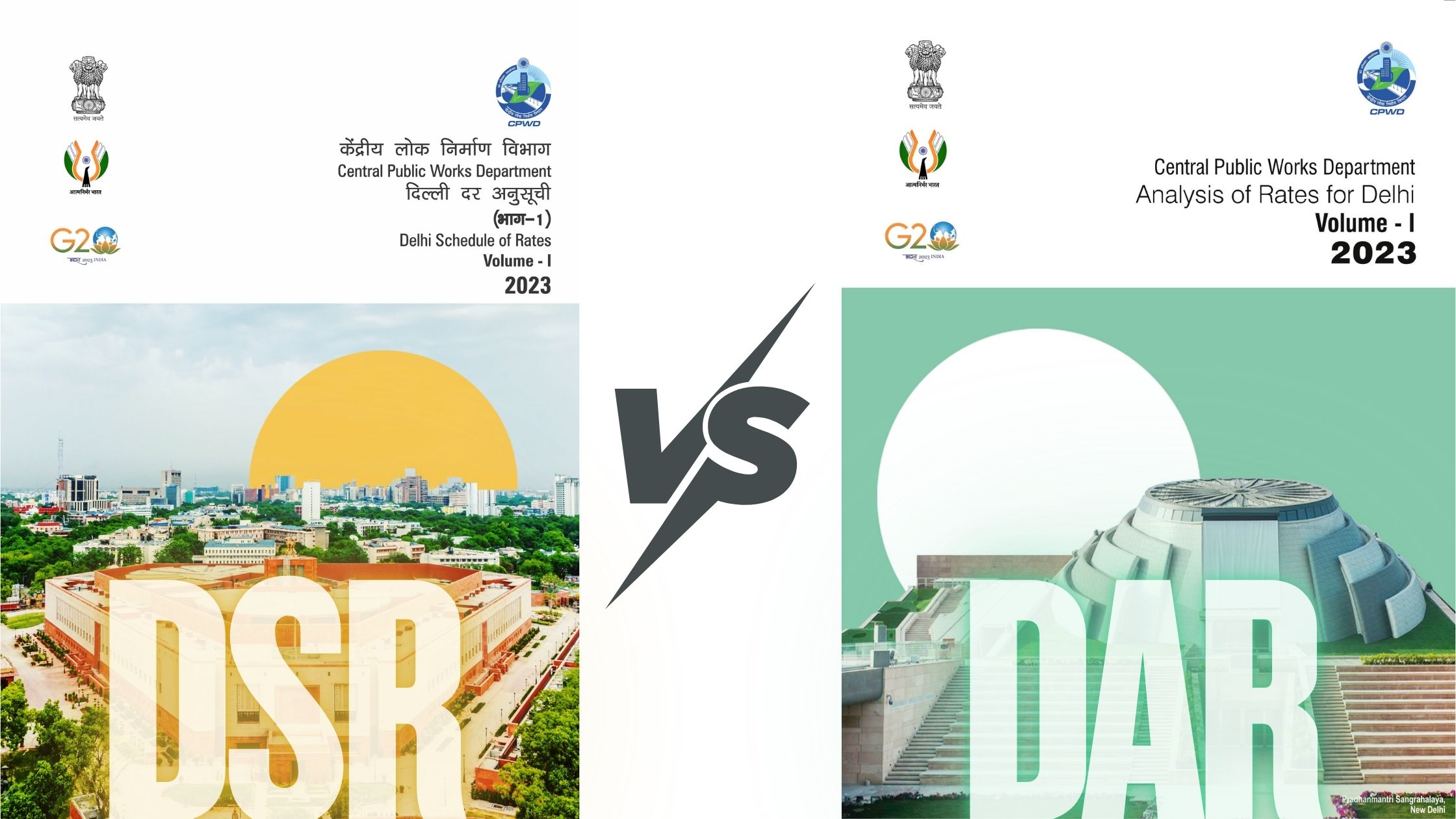
Ask any engineer what the 15% CP&OH in the CPWD DSR rates covers, and most will tell you it is the contractor’s profit. It isn’t — at least not all of it. Only half of the 15% is profit; the other 7.5% is a defined basket of site overheads. Price or justify a job on the wrong assumption and that 7.5% comes straight out of your own pocket. So here is the full break-up.
So what is CP&OH, and why isn’t it all profit?
CP&OH stands for Contractor’s Profit and Overhead. The 15% you see added in every rate analysis is not a single number — it is two halves. Half of it, 7.5%, is the contractor’s profit. The other 7.5% is the contractor’s overhead: a defined set of site costs the contractor carries but that no individual item rate pays for. CPWD spells this out in the Standard Operating Procedure that accompanies its Works Manual — SOP 5/3, Justification of Tenders (2024 edition), Clause 9.
That split holds right across CPWD. The Civil, the Electrical & Mechanical (E&M) and the Horticulture wings all use the same 15%, and it applies to every kind of item — Schedule and Non-Schedule alike — not only for estimation but for tender justification and for the payment of extra or deviated items sanctioned on market rates (SOP 5/3, Clause 8). The same 15% CP&OH convention runs through the Indian Railways schedules too: USSOR and the regional SoRs carry it the same way, 7.5% profit and 7.5% overhead.
There are some data books that do not follow this 15% rule. One example is the Ministry of Road Transport and Highways’ Standard Data Book for Analysis of Rates — the MORTH data book — which does not use a flat 15%. It works on a different contractor’s profit and on overheads that vary with the type of work. So the 15% CP&OH is not universal. It is correct for CPWD, it is correct for the Indian Railways, and it is usually correct for many of the state SoRs as well, but not always. The MORTH figures are a topic of their own, and a separate post will take them up.
What does the 7.5% overhead actually cover?
This is the half most people wave off as “overheads” without knowing what is inside it. SOP 5/3, Clause 9 does not leave it vague. It names exactly six factors that the 7.5% overhead accounts for:
- Cost of Engineering Establishment deployed by the Contractor.
- Cost of effort in arranging Tools and Plants (T&P) and heavy machinery which have not been considered in the analysis of rates for the items included in the Schedule of Quantities of the work.
- Cost of providing cleaner environment at site & labour welfare facilities.
- Cost of Quality Assurance set up enhancing testing lab including testing charges etc.
- Cost of Office set up including engagement of necessary staff for computerized billing etc.
- Any expenditure incurred on Cost of Earnest Money / Performance Guarantee / Security Deposits / Bank Guarantee (including e-Bank Guarantee).
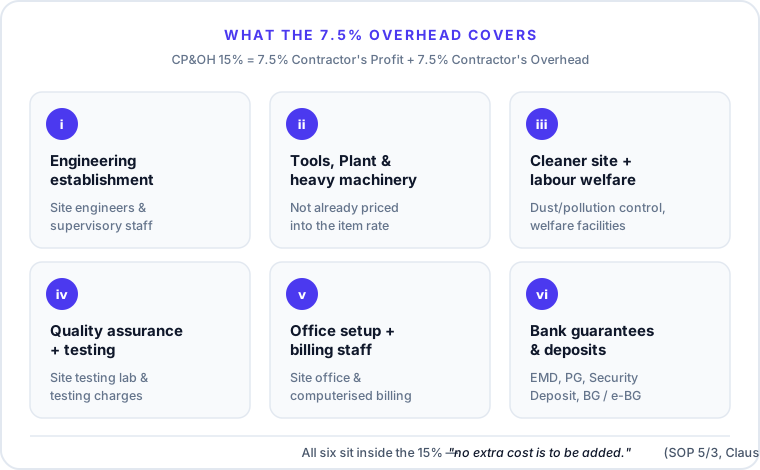 The six factors the 7.5% overhead covers — CPWD Works Manual SOP 2024, SOP 5/3, Clause 9.
Notice what this list is: a closed, named set, not a slush figure you can stretch to cover anything a contractor forgot to price. Site supervision, the testing lab, the site office and its billing clerk, the cost of arranging a bank guarantee — they are all in here, and they are all already paid for inside the 15%. That single fact decides a surprising number of claims, which is the next section.
”No extra cost is to be added”
Right after listing the six factors, SOP 5/3, Clause 9 closes with one line that carries more weight than its length suggests: “Therefore no extra cost is to be added in justification on account of various factors mentioned above.”
In plain terms: a contractor cannot bill you separately for the site office, the testing lab, the bank-guarantee charges or the site supervision. Those are inside the 15%. When you prepare a justification or re-analyse an item, you do not add a fresh line for the site set-up, the T&P or the testing lab. They are already counted in the 7.5% overhead.
”Extra cost to be added” — the one exception
There is one door this leaves open, and it is the very next clause. SOP 5/3, Clause 10 allows that extra cost on account of “any special conditions incorporated in NIT which has financial bearing… which are not covered or considered above and in the analysis of the rate of the items included in the BOQ of the work, are added on actual basis or by a rough approximation.”
So a genuine special condition written into the NIT, with a real financial bearing and not already covered by the six factors, can be added — on actuals, or by a fair approximation where exact analysis is not possible. The distinction is the whole game. A vague “site conditions” claim fails; a specific NIT special condition with a financial bearing is the legitimate route. The six standard overheads are not.
Where the 15% sits in the rate — and what the 2024 OM changed
The 15% itself has not changed. What changed is what it sits on top of.
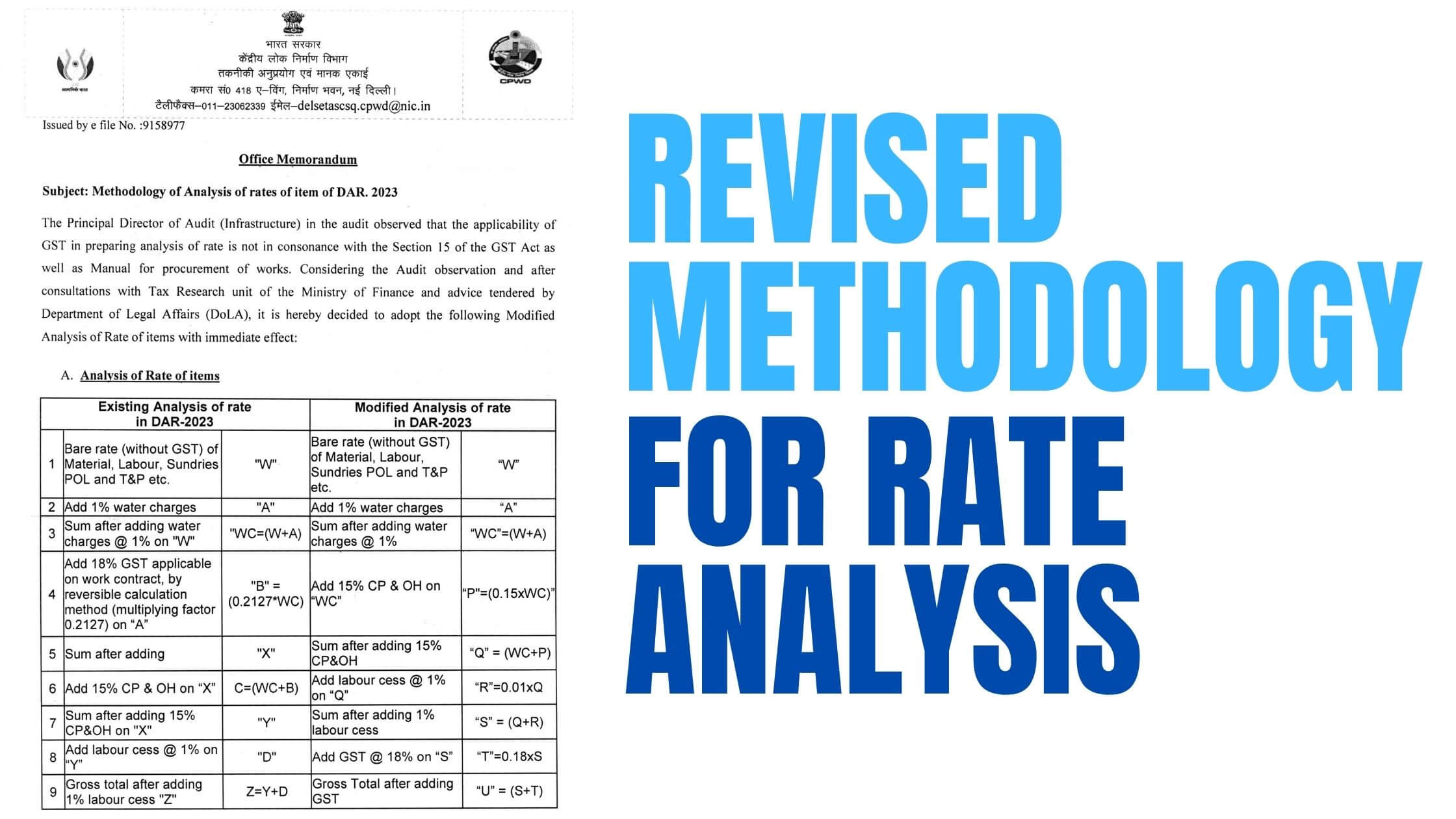
Under the old printed DAR 2023 method, GST was applied early, and the 15% CP&OH was then layered on a GST-inclusive figure — in effect, on Total + Water Charges + GST.
CPWD’s OM dated 08-Aug-2024 moved GST to the very end of the cascade, so the 15% now sits on the pre-GST works value, i.e. on Total + Water Charges only.
The cleanest way to see it is to take one item all the way through. Below is the full analysis of rates — the DAR behind the rate — for DSR 2023 item 5.33.2.1, M25 design-mix concrete, per cubic metre. (If the idea that a rate is built from material, labour and machinery is new, start with the difference between DSR and DAR.)
Table 1 — Analysis of rates for item 5.33.2.1, M25 concrete (per cum)
| Component | Qty | Unit | Rate ₹ | Amount ₹ |
|---|---|---|---|---|
| Material | ||||
| Stone aggregate, 20 mm single size | 0.57 | cum | 1,425.00 | 812.25 |
| Stone aggregate, 10 mm single size | 0.28 | cum | 1,400.00 | 392.00 |
| Carriage of stone aggregate (below 40 mm) | 0.85 | cum | 0.00 | 0.00 |
| Coarse sand (zone III) | 0.425 | cum | 1,450.00 | 616.25 |
| Carriage of coarse sand | 0.425 | cum | 0.00 | 0.00 |
| Portland cement (OPC-43 grade) | 0.33 | tonne | 5,156.00 | 1,701.48 |
| Carriage of cement | 0.33 | tonne | 0.00 | 0.00 |
| Plasticizer / super plasticizer (0.5% of cement) | 1.65 | kg | 30.00 | 49.50 |
| Production & placing | ||||
| Production of concrete by batch-mix plant | 1 | cum | 450.00 | 450.00 |
| Pumping charges (P) | 1 | cum | 250.00 | 250.00 |
| Labour — pouring, consolidating & curing | ||||
| Mason (average) | 0.17 | day | 857.00 | 145.69 |
| Beldar | 2 | day | 736.00 | 1,472.00 |
| Bhisti | 0.9 | day | 816.00 | 734.40 |
| Vibrator (needle type, 40 mm) | 0.07 | day | 400.00 | 28.00 |
| Sundries | 13 | L.S. | 2.27 | 29.51 |
| Height adjustment | ||||
| Extra piping up to floor V level (= 100% of P) | 1 | — | 250.00 | 250.00 |
| Total W — analysis total | 6,931.08 |
The three carriage lines sit at ₹0.00 here because cartage is lead- and location-dependent, and the CPWD base rate is struck for Delhi at nil lead. On your project you populate them for your site — which is exactly the kind of thing a market-rate justification has to rebuild.
Now take that Total W = ₹6,931.08 and run the add-ons under each method. Watch the CP&OH line in both.
Table 2a — Old method (pre-OM cascade)
| Step | Applied on ₹ | Rate | Amount ₹ | Running total ₹ |
|---|---|---|---|---|
| Total W | — | — | — | 6,931.08 |
| + Water Charges | 6,931.08 | 1% | 69.31 | 7,000.39 |
| + GST | 7,000.39 | factor 0.2127 | 1,488.98 | 8,489.37 |
| + CP&OH | 8,489.37 | 15% | 1,273.41 | 9,762.78 |
| + Labour Cess | 9,762.78 | 1% | 97.63 | 9,860.41 |
| Say | 9,860.40 |
Table 2b — Modified method (post 08-Aug-2024 OM)
| Step | Applied on ₹ | Rate | Amount ₹ | Running total ₹ |
|---|---|---|---|---|
| Total W | — | — | — | 6,931.08 |
| + Water Charges | 6,931.08 | 1% | 69.31 | 7,000.39 |
| + CP&OH | 7,000.39 | 15% | 1,050.06 | 8,050.45 |
| + Labour Cess | 8,050.45 | 1% | 80.50 | 8,130.95 |
| + GST | 8,130.95 | 18% | 1,463.57 | 9,594.52 |
| Say | 9,594.50 |
At the finished-rate level, the two methods relate by a single number: 9,594.50 ÷ 9,860.40 = 0.973. That is the one correction factor CPWD allows you to apply, and the full reason it comes out constant is in why the DSR 2023 rates changed after the 08-Aug-2024 GST OM.
But the CP&OH line itself tells the story this post is about. Same item, same 15%, two very different figures: ₹1,273.41 under the old method, ₹1,050.06 under the new. The old one was 15% of a base that already had 21.27% GST stacked on it; the new one is 15% of the pre-GST works value. The two are not unrelated — 1,050.06 × 1.2127 = 1,273.41 — the CP&OH had been inflated by exactly the old GST factor. The headline correction factor is the same for everyone; the CP&OH underneath it is genuinely different.
Doing this in Costimator
Costimator applies the post-08-Aug-2024 cascade to every CPWD DSR 2023 item automatically, so the 15% always sits on the correct pre-GST value, and it shows the CP&OH as its own line in the analysis rather than burying it in a correction factor. When you are bidding at a margin different from the standard 15%, Costimator also lets you override the CP&OH — along with GST, Labour Cess and Water Charges — per project.
See it for yourself → explore the features or start a free 14-day trial.
Is it part of the 15% CP&OH? — a quick reference
The fastest way to settle an argument at the billing table. If a cost is inside the 15%, it cannot be billed again. If it is outside, it is handled on its own.
| Cost / item | Part of the 15% CP&OH? | Where it sits |
|---|---|---|
| Site engineers & supervision | ✓ | Clause 9 (i) |
| T&P not already in the item rate | ✓ | Clause 9 (ii) |
| Heavy machinery not in the item rate | ✓ | Clause 9 (ii) |
| Cleaner site, dust & pollution control | ✓ | Clause 9 (iii) |
| Labour welfare facilities | ✓ | Clause 9 (iii) |
| Site testing lab | ✓ | Clause 9 (iv) |
| Material testing charges | ✓ | Clause 9 (iv) |
| Site office | ✓ | Clause 9 (v) |
| Computerised-billing staff | ✓ | Clause 9 (v) |
| Earnest Money (EMD) | ✓ | Clause 9 (vi) |
| Performance Guarantee (PG) | ✓ | Clause 9 (vi) |
| Security Deposit | ✓ | Clause 9 (vi) |
| Bank Guarantee / e-BG charges | ✓ | Clause 9 (vi) |
| Contractor’s profit margin | ✓ | the other 7.5% |
| EPF (contractor’s share) | ✗ | Reimbursed on actuals — Clause 7 |
| ESI (contractor’s share) | ✗ | Reimbursed on actuals — Clause 7 |
| Special NIT condition with financial bearing | ✗ | Added on actuals — Clause 10 |
| Water Charges (1%) | ✗ | Separate add-on, before CP&OH |
| Labour Cess (1%) | ✗ | Separate add-on, after CP&OH |
| GST (18%) | ✗ | Statutory tax, applied last |
Common mistakes that invite audit objections
Treating the whole 15% as profit. Only 7.5% is profit. Price a bid as if the full 15% is margin and the 7.5% of real overhead cost comes out of your own pocket; sit on the department side of the table and you overstate how much is actually negotiable.
Letting a covered overhead be claimed twice. A contractor asks for the testing lab, the bank-guarantee charges or the site office on top of the 15%. Clause 9 has already paid for them. In my CPWD years, this is the file that came back every time.
Confusing a special NIT condition with the standard overheads. Clause 10 is for a specific condition written into the NIT with a financial bearing, not a re-labelling of the six factors you are already getting under Clause 9.
Dropping CP&OH from a non-schedule item. The 15% applies to Non-Schedule items too (CPWD Works Manual 2024, SOP 5/3, Clause 8). A market-rate justification for an NS item that forgets it is simply short.
Folding EPF/ESI into the analysis. It does not belong in the rate; it is reimbursed on actuals (Clause 7).
Using the CPWD 15% on a road or bridge. Those follow the MORTH data book, not the flat 15%.
FAQ
Is the 15% CP&OH all profit? No. It is 7.5% contractor’s profit and 7.5% contractor’s overhead (CPWD Works Manual SOP 2024, SOP 5/3, Clause 9).
Did the 08-Aug-2024 OM change the 15%? No. The 15% rate is unchanged. The OM only changed what it is applied on: with GST moved to the end of the cascade, the 15% now sits on the pre-GST value (Total + Water Charges) instead of a GST-inclusive figure.
Does the 15% CP&OH apply to non-schedule items? Yes. Clause 8 applies it to all Schedule and Non-Schedule items, for estimation, justification and the payment of extra / deviated items.
Is extra T&P cost added for E&M works? No. For E&M works, SOP 5/3 (Clause 11) says no extra cost for T&P is added in the Standard Analysis of Rates, whether you are working out the estimated cost of an item or its market-rate justification.
Resources & official sources
This post is built on CPWD’s own documents. To check any of it against the source:
- CPWD Works Manual 2024 and its SOP 2024 — SOP 5/3, Justification of Tenders (Clauses 2, 7, 8, 9, 10, 11) is the authority for the 15% split, the six factors and the exceptions.
- The 08-Aug-2024 GST methodology OM — File No. 158/SE (TAS)/GST/2024/02-E, the order that moved GST to the end of the cascade.
- CPWD Website · All CPWD Publications
- CPWD DAR 2023 (Civil): Vol-1 · Vol-2
- Related reading: DSR vs DAR — what’s the difference? · Why the DSR 2023 rates changed after the 08-Aug-2024 GST OM