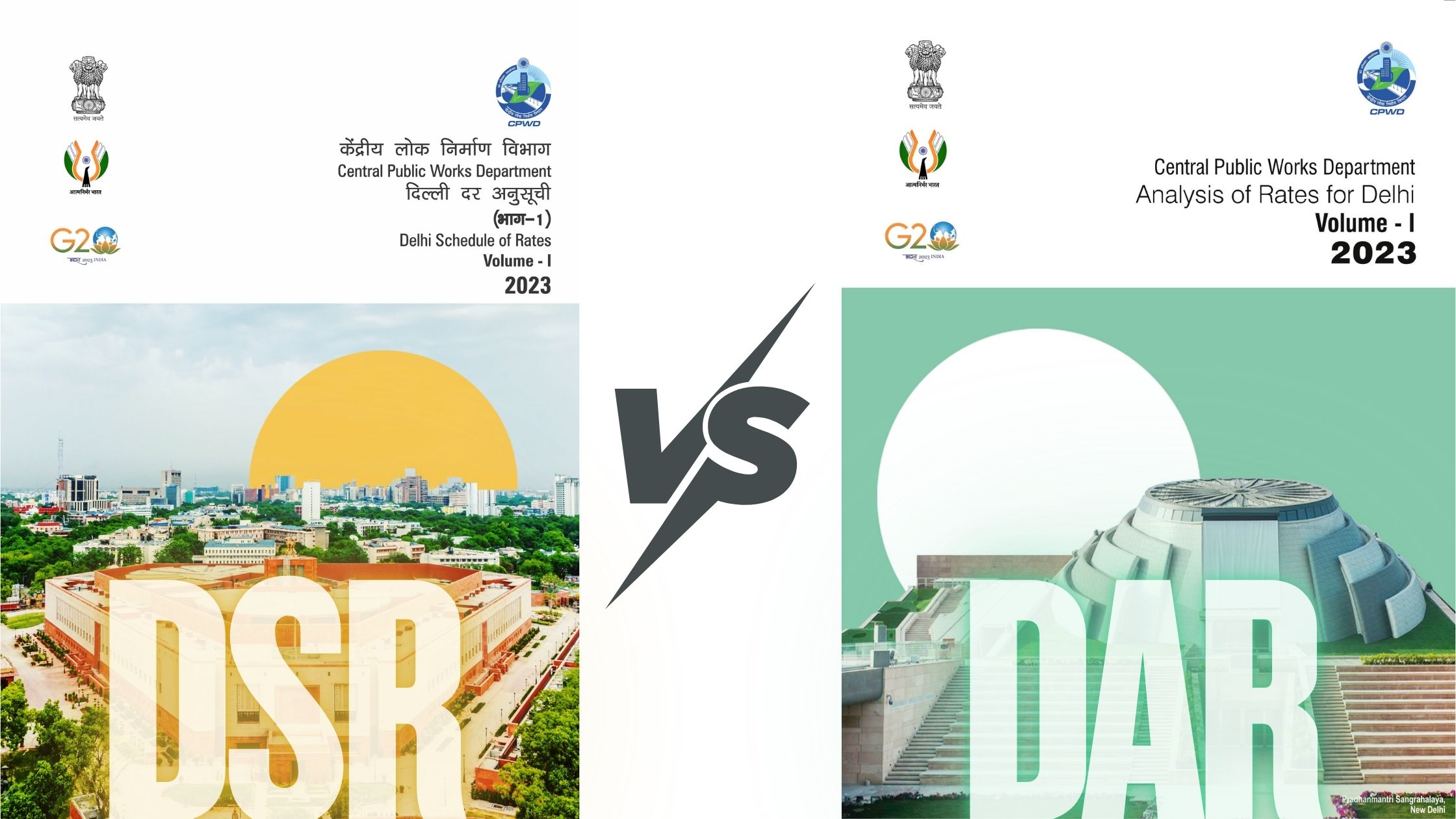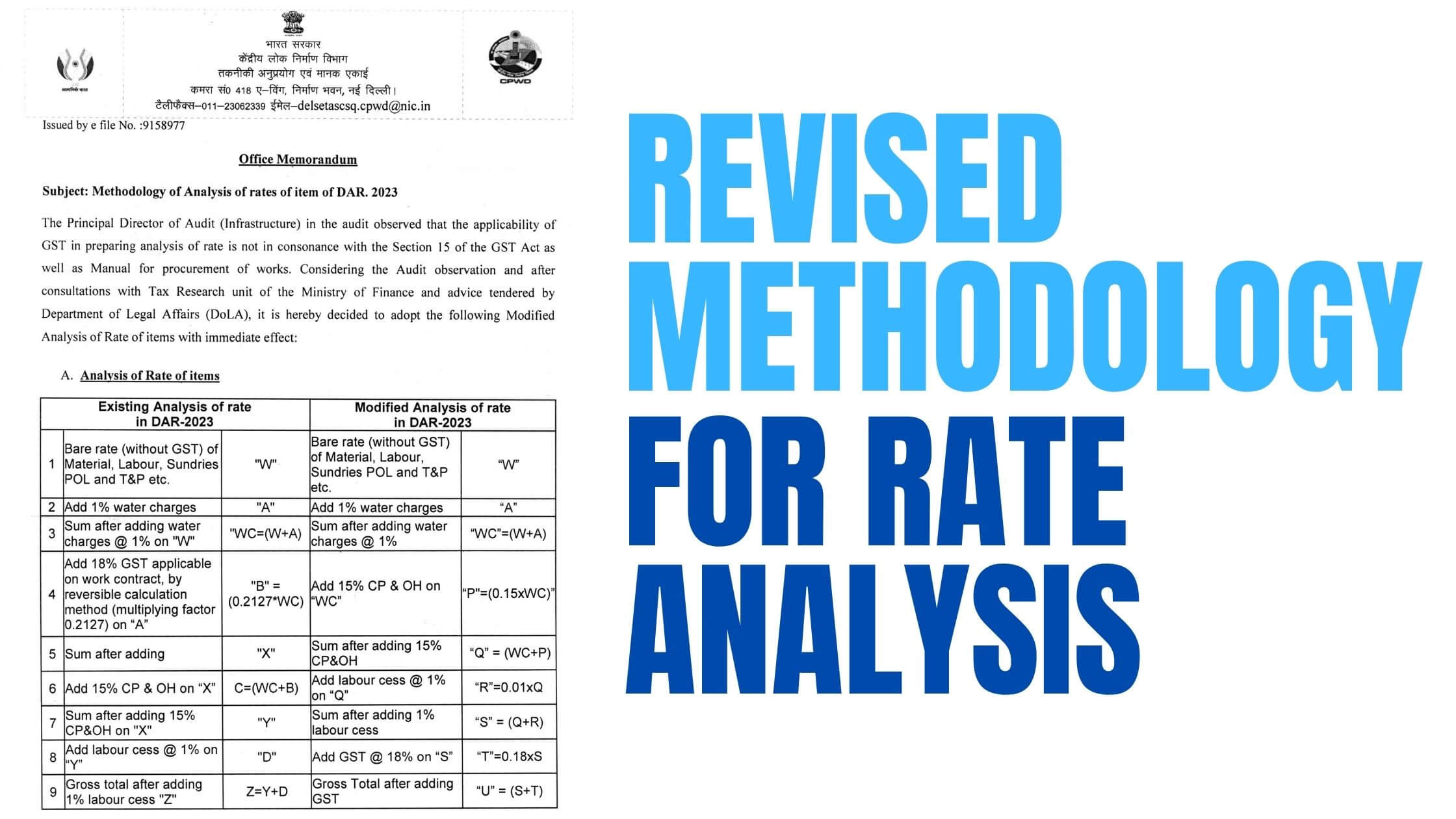
On 08 August 2024, CPWD changed how every DAR 2023 rate is built — and with it, in effect, every DSR 2023 rate in the printed book and the published PDF.
Not the basic rates, and not the items that build up the analysis. What changed is the order in which GST, contractor’s profit (CP&OH), and labour cess are applied — and the GST figure itself. The result: almost every finished DSR 2023 rate comes out lower.
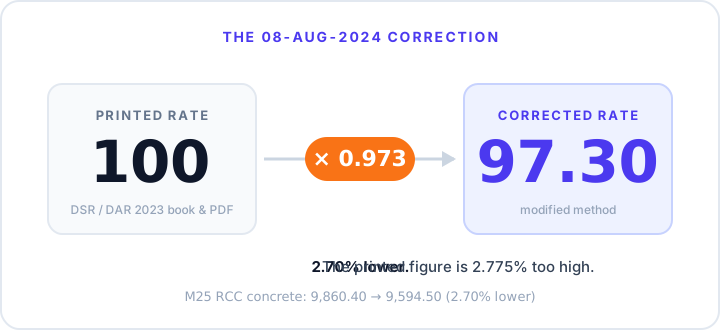
If you are still quoting the printed or PDF DSR or DAR 2023 rates, you are quoting a number that is now about 2.775% too high — the printed rate works out to 1 ÷ 0.973 = 1.02775 times the corrected one.
Quick answer: CPWD’s OM dated 08-Aug-2024 (File No.
158/SE (TAS)/GST/2024/02-E) revised the rate-analysis cascade for DAR 2023. The old printed method applied GST early — a0.2127factor on the sub-total — and then added CP&OH and Labour Cess on top of it. The modified method builds the full works cost first (1% Water Charges, then 15% CP&OH, then 1% Labour Cess) and applies 18% GST last. For a standard item this lowers the finished rate to almost exactly 0.973 × the old rate, which is why CPWD could allow a single correction factor.
What the 08-Aug-2024 OM actually changed
The DAR analysis of any item ends the same way it always has: you total the basic items (material, machinery, manpower) and any other dependent DSR items — into an analysis total, usually written as Total W. What the OM changed is everything that happens after W: the statutory and departmental additions, and the sequence they are applied in.
Under the old printed DAR 2023 method, the cascade was:
- Total W — the analysis of basic items
- + 1% Water Charges on W → Total X
- + 21.27% GST on X, using the multiplying factor 0.2127
- + 15% CP&OH (contractor’s profit and overheads)
- + 1% Labour Cess
The modified method under the OM keeps Water Charges where it was, but reorders the rest and applies a straight 18% GST at the very end:
- Total W
- + 1% Water Charges on W → Total X
- + 15% CP&OH on X → Total Y
- + 1% Labour Cess on Y → Total Z
- + 18% GST on Z
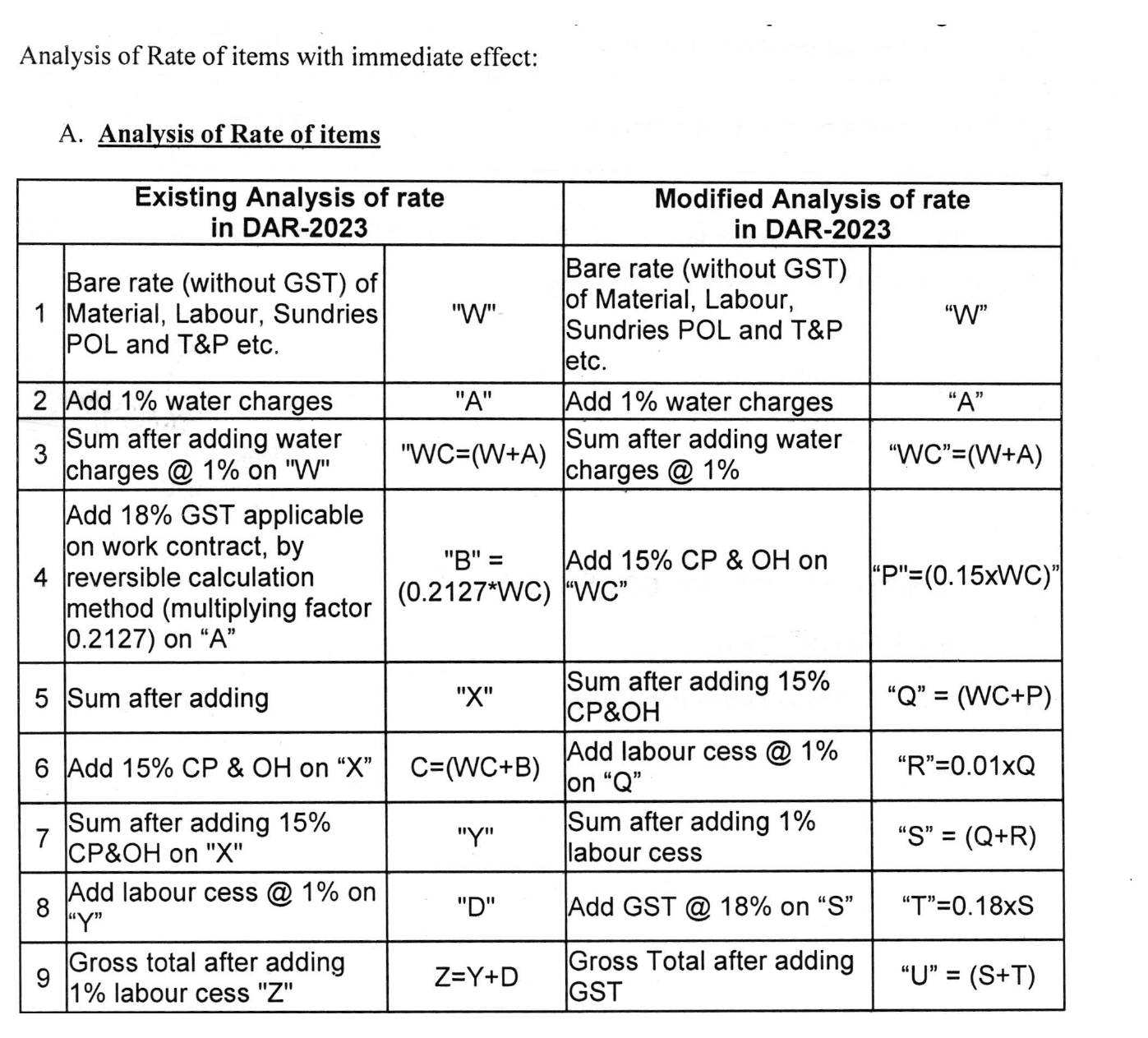 The existing (left) and modified (right) analysis of rate — from CPWD OM No. 158/SE (TAS)/GST/2024/02-E, dated 08-Aug-2024.
The principle behind the change is simple and correct: GST is a statutory tax on the works value, so it should be the last thing applied — after the contractor’s profit and the labour cess are already inside the cost. The old method applied GST in the middle, then layered CP&OH and cess on top of a GST-inclusive figure. The new method taxes the finished works value, which is what the law intends.
This was not a discretionary tweak. The OM records that the Principal Director of Audit (Infrastructure) found the old treatment inconsistent with Section 15 of the GST Act and the Manual for Procurement of Works; CPWD adopted the modified method after consulting the Ministry of Finance’s Tax Research Unit and the Department of Legal Affairs. The same OM supersedes CPWD’s earlier 2018 GST OM (No. DG/SE/GST/16, dated 28-May-2018).
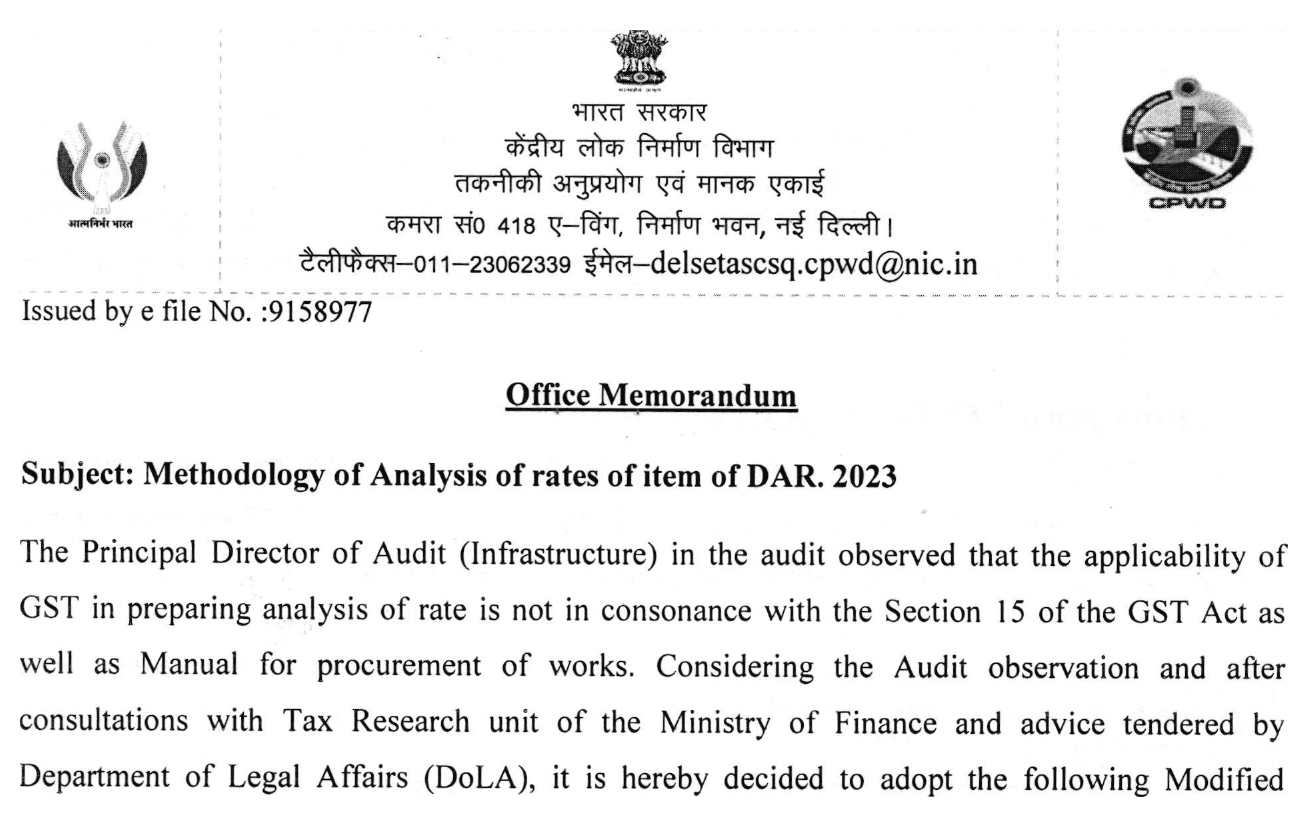 The opening of CPWD OM No. 158/SE (TAS)/GST/2024/02-E (08-Aug-2024) — the audit observation that set the change in motion.
Worked example: M25 design-mix concrete (DSR 2023 item 5.33.2.1)
Take CPWD DSR 2023 item 5.33.2.1 — design-mix M25 concrete for RCC work, above plinth up to floor V level, measured per cum. Its analysis total is Total W = ₹6,931.08. Here is the same item under both methods.
Old printed DAR 2023 method
| Step | Applied on | Rate | Amount ₹ | Running total ₹ |
|---|---|---|---|---|
| Total W | — | — | — | 6,931.08 |
| + Water Charges | W | 1% | 69.31 | 7,000.39 |
| + GST | X | factor 0.2127 | 1,488.98 | 8,489.37 |
| + CP&OH | Y | 15% | 1,273.41 | 9,762.78 |
| + Labour Cess | Z | 1% | 97.63 | 9,860.41 |
| Say | 9,860.40 |
Modified method (post 08-Aug-2024 OM)
| Step | Applied on | Rate | Amount ₹ | Running total ₹ |
|---|---|---|---|---|
| Total W | — | — | — | 6,931.08 |
| + Water Charges | W | 1% | 69.31 | 7,000.39 |
| + CP&OH | X | 15% | 1,050.06 | 8,050.45 |
| + Labour Cess | Y | 1% | 80.50 | 8,130.95 |
| + GST | Z | 18% | 1,463.57 | 9,594.52 |
| Say | 9,594.50 |
Same item, same basic-item analysis, same ₹6,931.08 base. The finished rate falls from ₹9,860.40 to ₹9,594.50 — a drop of ₹265.90, or 2.70%. And 9,594.50 ÷ 9,860.40 = 0.9730.
So which change drops the price — the reorder or the GST rate?
This is the part most explanations get fuzzy about, so let us be precise.
Every addition in the cascade is a percentage of the running total. Multiplication does not care about order: W × 1.01 × 1.2127 × 1.15 × 1.01 gives the same number whichever way you sequence those factors. So the reorder, on its own, does not change the total at all.
The entire 2.7% reduction comes from one thing: the GST figure changed from the old 0.2127 factor to a straight 0.18. And 1.18 ÷ 1.2127 = 0.9730 — exactly the drop you see in the example.
So both statements are true, and they are about different things:
- In principle, the reorder matters — it fixes what is being taxed (the finished works value, not a part-built figure with CP&OH and cess stacked on a GST-inclusive amount).
- In rupees, the reorder is neutral; the drop is the GST figure moving from 0.2127 to 0.18.
That is precisely why CPWD could issue a single correction factor instead of asking everyone to re-analyse every item.
Does every DSR 2023 item move by exactly 0.973?
Because the change is a fixed swap of the same percentages, every item whose analysis carries only these four additions — Water Charges, CP&OH, Labour Cess, GST — lands at the same 0.973 multiple of its old rate. Here is the same comparison across a spread of common items, straight from the schedule:
| DSR 2023 item | Unit | Old method ₹ | Modified method ₹ | Factor |
|---|---|---|---|---|
5.33.2.1 — M25 design-mix RCC concrete | cum | 9,860.40 | 9,594.50 | 0.9730 |
14.25 — Brick work, class 7.5, in mud mortar | cum | 6,207.25 | 6,039.85 | 0.9730 |
13.13 — 12 mm cement plaster 1:2 | sqm | 378.70 | 368.45 | 0.9729 |
13.15 — 20 mm cement plaster 1:2 | sqm | 520.55 | 506.50 | 0.9730 |
22.3 — Waterproofing treatment, vertical & horizontal | sqm | 769.60 | 748.85 | 0.9730 |
26.65 — 0.8 mm galvanized steel roof decking sheet | sqm | 1,525.60 | 1,484.45 | 0.9730 |
The tiny 0.9729 on the 12 mm plaster is just rounding at a small rupee value. The pattern is otherwise exact, across concrete, masonry, plaster, waterproofing, and steel.
We checked this against the whole schedule, and almost every listed DSR 2023 item moves by the same 0.973. The few that don’t are intermediate items that carry no GST, CP&OH or cess in the schedule at all — those additions are applied later, in the finished item that consumes them, so there is nothing for the factor to act on.
So for a quick estimate built from scheduled items, the factor is dependable. It adjusts the number, though — not the analysis.
The 0.973 shortcut versus rebuilding the analysis
The OM itself allows the shortcut: until the modified rates are updated in the printed books or officially published PDFs of DSR & DAR, you may multiply the existing rate by 0.973. That is fine for a quick estimate using scheduled items.
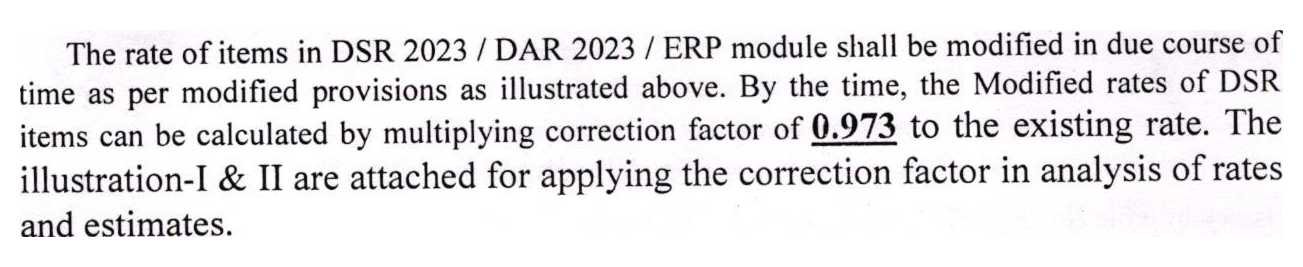 CPWD OM No. 158/SE (TAS)/GST/2024/02-E permits the
 0.973 factor until the DSR / DAR / ERP rates are formally updated.
But the shortcut only gives you the adjusted number. It does not give you the adjusted analysis. The moment a rate has to be justified — a tender justification, a market-rate analysis, an audit reply, or a non-schedule item built from these basics — you should rebuild the cascade in the modified order with the correct GST step, not paste a corrected figure. A justification stands on its working, not on a multiplier.
This is also where the distinction between the schedule and the analysis matters; if that distinction is still fuzzy, start with DSR vs DAR and come back.
What this means for your estimates and tenders
- Quoting from the schedule: use the modified (post-OM) rate, or the printed rate × 0.973. Quoting the raw printed DAR 2023 rate now overstates the figure by ~2.7%.
- Justifying a rate: rebuild the analysis in the modified cascade — CP&OH, then Labour Cess, then 18% GST last — with the basic rates relevant to your place and time.
- Answering audit: audit will expect the current methodology. A file still built on the old GST-early cascade is an easy objection to raise.
FAQ
What is the correction factor for CPWD DAR 2023 after the 2024 OM?
0.973. The OM allows existing rates to be multiplied by 0.973 until the modified rates are published in the DSR / DAR / ERP module. It works because the methodology change reduces a standard item’s finished rate to 0.973× its old value.
Does the 0.973 factor apply to every DSR 2023 item?
For standard items carrying the usual four additions (Water Charges, CP&OH, Labour Cess, GST), yes — the factor is effectively constant. Items with a different additions set, or that link to other analysed items, should be rebuilt rather than factored.
Is GST now applied at 18% in CPWD rate analysis?
Yes. The modified method applies a straight 18% GST as the final step, after CP&OH and Labour Cess. The old method used a composite 0.2127 factor applied earlier in the cascade.
Did the basic rates change too?
No. The basic item rates and the analysis total (W) are unchanged. Only the additions cascade after W changed.
How Costimator handles this
Costimator applies the post-08-Aug-2024 cascade to every CPWD DSR 2023 item automatically — Water Charges, 15% CP&OH, 1% Labour Cess, then 18% GST last — so the finished rate you see is already on the modified methodology, with the full DAR breakdown behind it. You can open any item, see the cascade step by step, and export the analysis. No correction factor to remember, and nothing to re-key when you move from a quick estimate to a justification.
The methodology is not hard. But it is exactly the kind of detail that quietly makes a file wrong — an old rate here, a GST step in the wrong place there. Getting it right once, for every item, is the whole point.
See it for yourself → explore the features or start a free 14-day trial.
Resources & official sources
This post is built entirely on CPWD’s own documents. To check any of it against the source:
- The 08-Aug-2024 GST methodology OM — File No. 158/SE (TAS)/GST/2024/02-E, the order this post explains
- CPWD Website
- All CPWD Publications
- CPWD DSR & DAR 2023 (Civil)
- Related reading: DSR vs DAR — what’s the difference?